
Searching Iredell County Criminal Dockets
The North Carolina eCourts Portal is the online entry point. Iredell joined the Odyssey system on October 13, 2025. Since then, Smart Search has carried the public route to Iredell criminal case information. A case number helps. Grab one from a notice, citation, or older case record. It beats guessing. Without a number, type the name last name first and hit Submit. Apply the Iredell Location filter when the statewide list runs too wide.
Search and filing are separate services on the Portal. You can search without registering, though signing in adds a My Cases folder. Click an underlined result number to open the Register of Actions, the Portal's name for the chronological Case Summary. Depending on the record, the page may also show a Hearings section, disposition information, or Financial Information.
- Open Portal Smart Search and enter the case number, or a name in last-name, first-name order.
- Use the optional Iredell Location and Case Type or Case Status filters to narrow a broad result list.
- Open the underlined case number and read the Register of Actions in date order.
- Use Search Hearings or the Iredell criminal calendar to confirm an upcoming setting.
- Contact the Clerk for a public terminal, a paper file, or a certified document.
Iredell Criminal Docket Codes
Iredell criminal records from different divisions live side by side in the Portal. The state's criminal activity report tags Superior Court criminal records with CRS, District Court criminal records with CR, and infractions with IF. Those codes tell you where a case sits. A misdemeanor or infraction points to District Court. Felony context points to Superior Court. Keep one thing clear, though: the code says nothing about how the case came out.
Odyssey numbers mix a year, case type, sequence, and county identifier. There is no safe Iredell-only sample suffix to copy. Take the number exactly as printed on an Iredell citation, notice, prior docket, or Portal result. A demonstration number from another county will mislead you.
- Register of Actions
- The chronological court history shown in Portal, also called a Case Summary.
- Called and failed
- An AOC code for failure to appear for court.
- Trial de novo
- A new Superior Court trial after a District Court appeal in the statutory setting.
Inside a Iredell County Criminal Docket
Not every criminal docket fills in every field. The official Portal guide lists a case-number link, a Case Summary menu, chronology, conditional hearing and financial sections, dispositions, masked date-of-birth details, and suppression of confidential material. So read the label and the date together. A short code alone, cut off from the Register events around it, never tells the whole story of the case.
| Case number | The link that opens the Iredell Register of Actions. |
|---|---|
| Case status | A category-dependent label such as Pending, Appealed, Reopened, Stayed, or a Disposed value. |
| Hearings | Settings that appear when hearing information exists; confirm the newest listed event. |
| Register entries | Dated filings, notices, hearings, orders, transfers, appeals, or dispositions. |
| Financial information | A conditional Portal section, not a substitute for the Clerk’s current official record. |
Iredell Criminal Docket Conversion
The October 2025 conversion folded Iredell into the statewide Enterprise Justice and Odyssey rollout. That step is why a statewide search now reaches public Iredell records at all. It does not put every historic document image online. The Portal's own access materials warn that legacy conversion and pre-scanning vary. That variance runs county to county. So a missing image means you should try the Clerk's file route. Do not assume no record exists.
The Judicial Branch's Iredell eCourts announcement confirms the launch date. Attorneys file through North Carolina File & Serve. That is a filing service, not the public criminal docket search. Confusing the two leads to dead ends.
Legacy systems came along in the conversion, yet the official materials repeat that pre-scanning varies. An Iredell criminal result can show a full Register while historic filing images stay offline. Use the Register to name the event or document you need. Then ask the Iredell Clerk. The county file, a terminal, or another lawful channel may hold the underlying record.
Iredell Criminal Docket Hearings
Portal Search Hearings is the Iredell criminal-date tool. Use it when the case history alone leaves the court date unclear. Pick Iredell as the Location. Choose a Hearing Type and Search Type. Enter a case, party, attorney, judicial officer, or courtroom criterion. Add a date range and submit. Trust the newest hearing over an old notice that still sits in the Register as history.
Check the result against the Iredell criminal calendar too. If the setting is still fuzzy, the Criminal and Traffic desk at 704-832-6602 and the Clerk record route at the Hall of Justice are the documented local fallbacks. That matters most after a reset, a weather cancellation, or a transfer entry.
How a Criminal Case Moves
An Iredell criminal Register can begin with a citation, summons, warrant, complaint, or indictment. Later dated entries may document a setting, notice, hearing, order, transfer, appeal, or disposition. The broad sequence is Filing → Arraignment → Pretrial → Plea or Trial → Disposition → Sentencing. Individual cases do not always follow every stage in that order, so the current hearing and later entries matter more than an early notice.
Read a disposition label alongside whatever came after it. Portal's documented filter values include several Disposed categories plus Trial De Novo. The Register answers history, Search Hearings answers a case-specific setting, and the Iredell criminal calendar answers court calendar context. Each tool covers one question.
Courts That Hold Criminal Dockets
Two courts hold the criminal dockets in Iredell County. Superior Court takes the felony cases and other higher-court matters. It sits in Superior Court District 32. District Court handles misdemeanors, traffic tickets, and infractions. Both divisions file through the Iredell County Clerk of Superior Court and its Portal system. There is no separate county criminal clerk. There is no justice court and no city criminal docket to search.
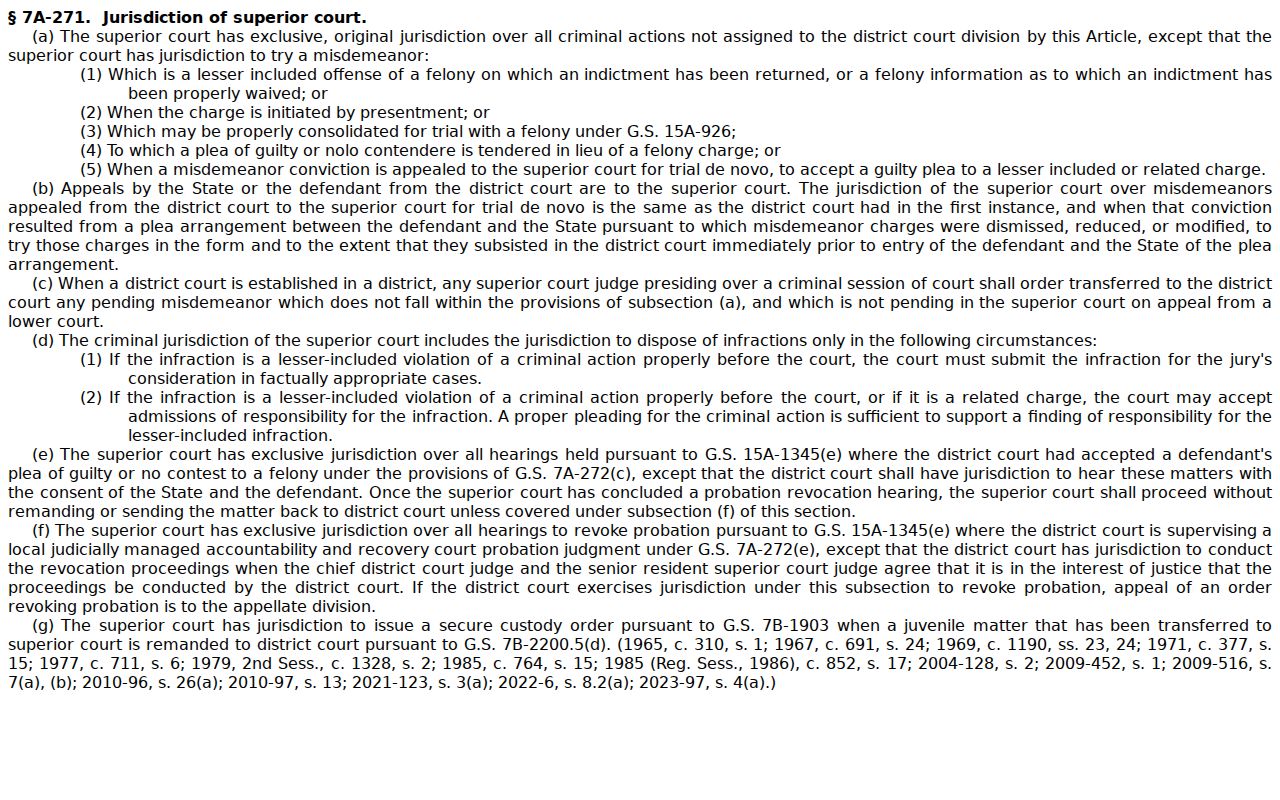
Cases can move between them. A District Court appeal goes to Superior Court for a fresh trial under G.S. 7A-271. Watch for entries reading Transferred to Superior Court or Appealed. The real action may then sit in a different division than where the case began. For local contacts and the courtroom itself, the Iredell court hub and local resources page is the place to check.
That divisional drift matters for any Iredell County criminal docket search. Track the current division, not just the original case label. The Superior Court jurisdiction source lays out the appeal path in full, and it is worth reading before you chase a case number across both courts.
The division label is a routing tool, not a second record system. One unified Clerk keeps the county file. The division simply tells you where the case is being heard right now.
Iredell Criminal Docket Context
Official FY2024 tables count 721 felony convictions in Iredell. That works out to 4 per 1,000 adults. Misdemeanor convictions totaled 3,198, or 20 per 1,000 adults. These are convictions, not open cases, filings, or a count of current criminal dockets. Treat the figures as a scale check. They never replace an individual Portal lookup across the two divisions.
The annual county criminal and infraction activity report is the official source for filings, pending cases, and dispositions. It is published every year. Conviction numbers are background only. They say nothing about an individual criminal docket or a current court setting.
Iredell Criminal Docket Desk
A Portal search that returns 200 results needs narrowing. Add Iredell Location plus another supported advanced filter. If no cases match, check spelling and formatting first. Public-access limits can also hide results, so have another documented channel ready. The Iredell Criminal and Traffic desk is 704-832-6602. The Clerk route runs through the Hall of Justice at 226 Stockton Street in Statesville, where public self-service terminals and county case files are available subject to law.
A certified copy takes more than a Portal view. The statewide court-records guidance sends users to the Clerk where the case sits for files and staff-provided copies. A certified criminal index search uses its own county-only AOC-CR-314 form. It is not a statewide certification. Nor does it replace asking the Clerk for a particular docket document.
Older paper-era records often never appear online. The Clerk's counter is the practical channel for those. Historic material may sit in a separate archive. Confirm any transfer with the Clerk first. When you ask, provide the case number, division, event date, and the exact document needed. That gives the local office a usable starting point. It also avoids guessing at what a record contains.
The official Iredell Hall of Justice page is the county location source for this work. Its public-terminal route helps you tell an online display question from a request for the county file. Criminal records, traffic records, civil matters, special proceedings, and estates all share the Clerk structure. For a criminal docket question, though, the Criminal and Traffic direct line remains the more precise Iredell contact.
Sealed Dockets and Public Access
G.S. 7A-109 makes clerks keep records, dockets, and indexes open to inspection during regular office hours. Another law or court order can still bar access. That rule is what backs ordinary public criminal access through Portal and the Clerk. It does not put every document online.
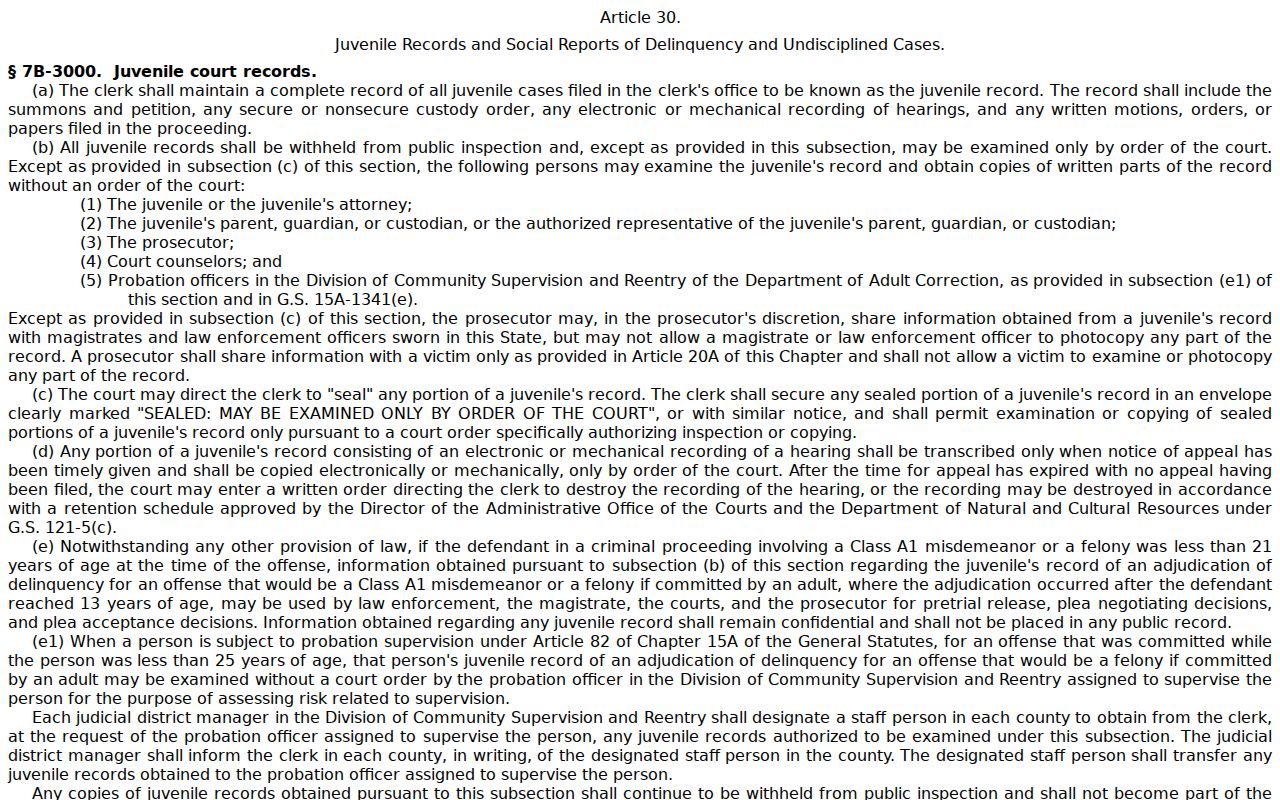
Access limits matter. G.S. 7B-3000 limits public inspection of juvenile delinquency records. G.S. 1-72.1 supplies a procedure for restricting covered judicial records. Portal also withholds sealed and confidential documents and masks some data.
The juvenile confidentiality source spells out the statutory restriction. A no-result is an access or search-format issue to resolve through the proper court channel, not a conclusion about any person or case.
For a public Iredell criminal case, start with Portal, then the calendar or hearing search. Confirm with the Clerk when a setting or record needs authoritative follow-up.
Public inspection is one thing; an expunction order is another. G.S. 15A-145.5 lays out one nonviolent-offense route. The filing fee is $175, subject to the statute's indigent exception. Not every dismissal, traffic matter, or older record qualifies. If an order is granted, what the public sees afterward follows the governing law and that order, not a manual Portal change request.
For an ordinary public case, keep the focus on court access. Identify the right Iredell record. Check the current hearing. Ask the Clerk for any lawful official copy. That sequence keeps the docket, the physical file, and a certified document each in their proper role. Each piece stays in its lane. It also stops a record label from being read without the dates and court events that give it context.